

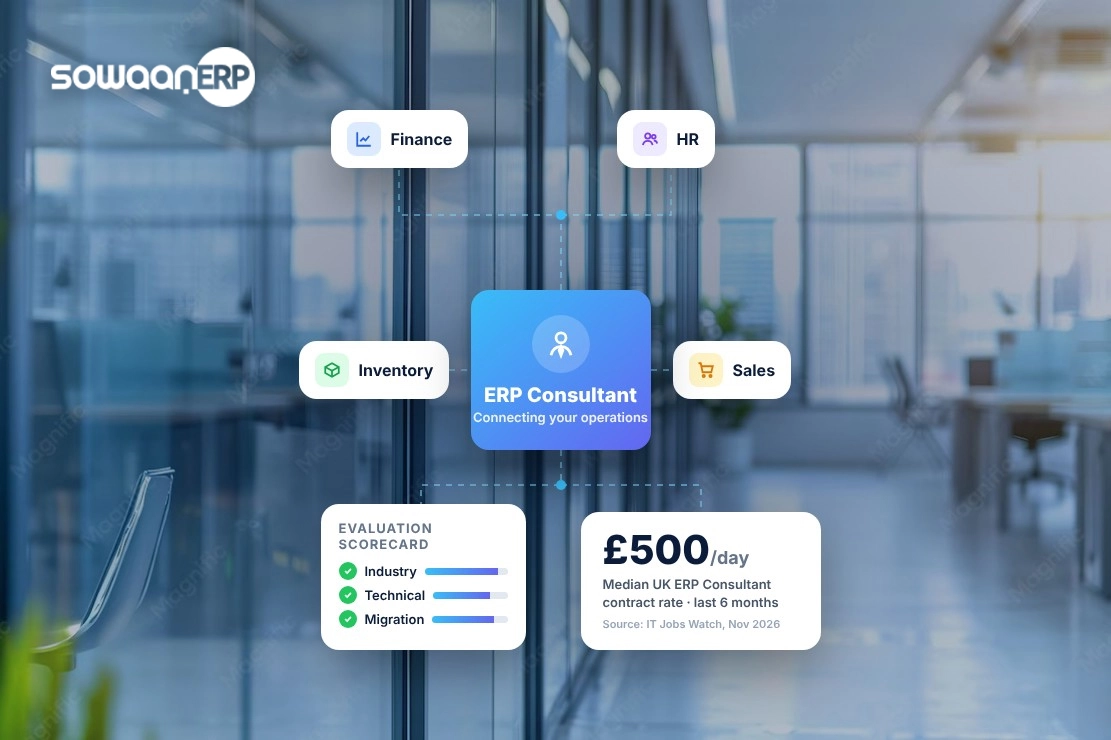
An ERP consultant works to determine, govern, and perform a business ERP software. They are involved in analyzing business processes, evaluating software, configuring systems, migrating data, and integrating software and delivering training to staff. According to IT Jobs Watch, the median daily rate for an advertised ERP contractor in the UK hit £500 for the 6 months to 3 November 2026.
By selecting the right expertise, companies can minimize potential implementation risks, enhance visibility into how they operate and gain the confidence that their technology investment is meeting real business goals.
What Does an ERP software consultant Do?
An ERP project impacts beyond just the software world. It transforms the way finance, HR, procurement, inventory, and sales & operations share data.
An erp software consultant can relate these business needs to the proper technology. They analyse existing processes, define process gaps and suggest a process implementation strategy to meet the business goal.
They’re accountable for their duties based on the engagement. Some specialize in software selection, others take care of implementations, integration, technical architecture or post-deployment optimization.
The primary goal is to integrate technology around a well-stated business need, rather than add another independent system.
1.1 Core Responsibilities
Embarking on a structured consultancy engagement will generally involve the following activities:
- Requirements analysis for business: Review the existing processes, reporting needs, departmental dependency, operational issues.
- ERP software selection: Make comparisons between platforms, modules, licensing, and technical capabilities with business requirements.
- Handling planning: Arrange the stages, tasks, involvement, goals, deadlines and criteria for receiving a project.
- Data Migration: Analyze Old database to identify duplicate data, Identify field mapping and validate data that has been migrated.
- System integration: Integrate ERP components with CRM, Payroll and Accounting software, e-commerce, warehouse and third party applications.
Source to target mapping, reconciliation and exception handling rules, validation rules should be included in the data migration. A successful moving of records will not guarantee that the moving records are accurate.
1.2 The Five Roles an ERP software consultant Plays
The value of consultancy becomes clearer when responsibilities are connected to business outcomes.
| Role | What it means for your business |
| Business analyst | Identifies process inefficiencies and documents requirements. |
| Technology adviser | Evaluates software architecture, modules and integrations. |
| Implementation planner | Controls project scope, timelines and delivery milestones. |
| Change management adviser | Prepares employees through communication and training. |
| Performance evaluator | Measures adoption, reporting accuracy and operational improvements. |
These erp business consultant functions can be delegated to other specialists in greater projects. Before entering into an agreement, businesses need to find out what someone would be responsible for owning each deliverable.
Connect Your Business Operations
Looking to bring finance, HR, inventory and operational workflows together? Explore Sowaan ERP and discover an integrated approach to business management.
2. ERP Consultant vs Implementation Partner vs Reseller
The two terms are used interchangeably, but are used to refer to different commercial relationships.
It’s important to know the difference because the ERP system consultant company that is giving you software recommendations could also make money from the sale or installation of the software.
| Evaluation factor | Independent erp business consultant | Implementation partner | Software reseller |
| Primary responsibility | Advice and project oversight | Configuration and deployment | Software licensing and sales |
| Main focus | Business requirements | Technical delivery | Product availability |
| Revenue model | Consultancy fees | Implementation fees | Licence or subscription margin |
| Vendor independence | Usually higher | Depends on partnerships | Usually product-dependent |
| Best suited for | Selection and independent review | Deployment and integration | Purchasing software licences |
A third party can provide a comparison of various platforms. Implementation partner is someone who understands how to deliver the product. There is a reseller who is responsible for license and commercial aspects.
These functions can, however, overlap. Other organisations offer advisory, implementation and licensing services as a package under one contract.
Don’t assume that being a reseller or implementation partner makes them unsuitable. Hold commercial relationships, technical know-how and contractual obligations in isolation.
2.1 When Does an Independent Consultant Make Sense?
There is increasing value in independent advice when:
- There is increasing value in independent advice when:
- You have multiple ERP options and no criteria for selection documented.
- There are conflicts within departments on system requirements.
- An external review of the proposed implementation budget is required.
- A dealer touts a lot of customisation but shows little proof of its importance.
- There are delays or budget constraints in your current ERP initiative.
Advantages
- Broader software comparison.
- Independent requirements assessment.
- Improved understanding of commercial hazards.
- Client-side project oversight.
Limitations
- Additional consultancy expense.
- May not offer with manual setup.
- Needs to be delivered with another partner.
- Suggestions must be owned by the individual.
Evaluate ERP Before You Invest
Compare your operational requirements with the capabilities of Sowaan ERP before committing to a new business management platform.
3. How Much Does an ERP Consultant Cost in the UK?
Firms charge fees for consultations, based on things like complexity of the project, the platforms’ expertise, business size, and responsibility.
The UK contractor market is a great place to start. IT Jobs Watch erp software consultant contract data has revealed that the average advertised daily rate for ERP over the last six months (to 3 November 2026) has been £500. This was obtained from a dataset of 18 quoted daily rates, so this should be used to indicate a market rate, not a supplier rate.
UK Advertised Contractor Benchmark
£500 per day
Median price of consultant contractors to ERP for the last 6 months in 3 November 2026
Getting into the ERP world as a contractor does not mean you’re being paid the same standard ERP consultant rate for a day. Specialist services and delivery duties, as well as agency fees and overheads can lead to higher fees.
Common ERP Consultancy Pricing Models
| Pricing model | How it works | Suitable for |
| Daily rate | Pay for each agreed working day. | Discovery, technical reviews and project support. |
| Fixed-fee engagement | Agree a price for defined deliverables. | Requirements analysis, readiness assessments and selection projects. |
| Monthly retainer | Pay an agreed recurring fee for ongoing support. | Governance, optimisation and advisory services. |
3.1 What Drives Consultancy Pricing?
A number of factors affects final commercial proposal:
- Business size
- ERP modules
- Software platform
- Integration complexity
- Data quality
- Customisation
- Project duration
Consider the total cost of ownership (TCO) from various factors, such as licences, implementation, infrastructure, integrations, expenses for training, maintenance, future upgrades, etc.
Understand Your ERP Investment
Explore Sowaan ERP to review business management capabilities and assess which functions your organisation needs to integrate.
4. Do You Need an ERP Consultant? When to Hire One
Not all tasks related to Erp software UK require external help. This will be based on their in-house knowledge, complexity of operations and the cost of the wrong decision.
Adopt the Decision Making Process below:
Step 1: Identify the business problem.
An existing ERP problem or disconnected systems, reporting delays.
Step 2: Establish the type of support required.
| Business requirement | Recommended support |
| Need to compare systems and define requirements | Independent advisory |
| Need configuration, migration and deployment | Implementation expertise |
| Existing implementation is delayed or failing | Independent project assessment and recovery support |
Step 3: Define responsibilities, budget, milestones and measurable outcomes.
Before software buying, an expert can be particularly beneficial. Getting involved early needs to be addressed as possible changes at the time of implementation which might result in costly requirements.
4.1 Signs Your Business Is Ready for ERP Consultancy
Consider external expertise if your organisation experiences several of these problems:
- Spreadsheet dependency
- Inventory inaccuracies
- Delayed financial reporting
- Multi-site complexity
- Manual approvals
- Limited operational visibility
- Growth limitations
These issues do not automatically mean a business needs a large enterprise platform. A properly scoped Erp software UK may address many requirements without unnecessary complexity.
Identify Your Operational Gaps
Explore Sowaan ERP to see how connected business processes can reduce information silos and improve operational visibility.
5. What Is the ROI of Hiring an ERP Consultant?
The benefit of a ERP consultant ought to be evaluated based upon operational and economic risks being minimized.
Actually, having a consultant is not a guarantee of project success. When they enhance the ability of decision-making and avoid unnecessary rework, and link the implementation activities to business goals to ensure measurable impact, their contribution is priceless.
By 2027, Gartner’s ERP research estimates over 70% of recently deployed ERP programs on their business case’s expected return-on-investment result. According to Gartner, strategic alignment and stakeholder support are other key success factors, as well. This underlines the importance of the right requirements discovery, project control and measurable project goals for implementation.
Tips: You should use a baseline measure before implementing to get an ROI. Monitoring processing time, stock accuracy, reporting turnaround, usage and error rates after roll-out.
6. How to Choose an ERP system Consultant and Identify Red Flags
Choosing the right expertise goes beyond checking out the quotes or when looking at their vendor certifications. Technical capability, industry knowledge, commercial transparency and project governance should be considered for businesses.
An ERP system consultant company has to show the real-life outcomes of its recommendations.
ERP Consultant Evaluation Scorecard
If you are evaluating potential suppliers, view this scorecard.
| Evaluation criteria | What to verify | Suggested weight |
| Industry experience | Completed projects in comparable industries | 20% |
| Technical expertise | Modules, integrations, APIs and architecture | 20% |
| Implementation methodology | Documented phases, milestones and testing | 15% |
| Data migration capability | Mapping, cleansing and reconciliation | 15% |
| Security and compliance | Access controls, audit trails and data protection | 10% |
| Training and support | UAT, employee training and post-go-live support | 10% |
| Commercial transparency | Clear fees, exclusions and change-control terms | 10% |
| Total | 100% |
Score each supplier from 1 to 5 against every criterion, then apply the relevant weighting.
Buyer Checklist: What to Verify Before Signing
- Ask for references for finished projects.
- Check up on the experience of the project lead suggested.
- Examine the methodology for implementing.
- Ask for a detailed statement of work (SOW).
- Verify that data and custom research is owned.
- Review responsibilities of integration/migration.
- Set up acceptance criteria and test process.
- Review the security and disaster protection measures.
- Verify support arrangements following go-live.
- Check out the termination, handover and exit clauses.
Red Flags to Watch For
- Ensured implementation timeframe ahead of requirements discovery.
- Lack of clarity from pricing and lack of documentation of additional fees.
- Over customisation of the vehicle with no fit gap assessment.
- Lacking clear ownership of the data migration.
- The following are comments on the absence of a user acceptance testing plan:
- Tuck-you-under-the-arms situations with vendors.
- No commitment for its post-implementation support.
Other issues raised by ERP practitioners are data cleansing, unexpected customisation, integration testing and employee training for implementing this. Such records are not indicative of universal results. Check out ERP implementation discussions on Reddit to gain insight into the kinds of concerns end users detail and implementers ask about.
8. ERP Consultants by Industry: Where Specialist Expertise Matters
The functions can vary from business to business. A generic approach to implementation may not account for important workflows, reporting requirements and integration requirements.
| Industry | Important ERP capabilities | Specialist knowledge to evaluate |
| Manufacturing | BOM, production planning, WIP and job costing | Production scheduling and material requirements planning |
| Construction | Project costing, procurement and subcontractor management | Contract budgets and project-based accounting |
| Distribution | Inventory, warehouse management and purchasing | Multi-warehouse stock control and order fulfilment |
| Retail | POS, purchasing and stock synchronisation | Omnichannel sales and product management |
| Healthcare | Procurement, finance and workforce administration | Access control, sensitive data and auditability |
| Education | Finance, HR Leave Management System and student administration | Departmental budgets and institutional workflows |
| Agriculture | Inventory, procurement and production tracking | Seasonal operations and resource planning |
| Nonprofit | Fund accounting, grants and donor management | Restricted funds and accountability reporting |
Knowledge of the industry is needed especially when software is required to handle processes other than accounting and administration.
For instance, manufacturers may need precise production structures and work-in-progress or bill of materials (BOM) tracking. Distributors require instant stock visibility across warehouses, while construction firms need project-level cost allocation and effective Vendor Risk Management Software to monitor supplier reliability and minimise procurement risks.
A suitable platform that provides these functionalities as standard.
Explore Industry-Specific ERP Capabilities
Discover Sowaan ERP’s business solutions and assess how integrated modules can support your industry’s operational requirements.
9. Common ERP Project Mistakes a Consultant Can Prevent
Typically, ERP implementation issues emerge even before it is set up. ERP implementation consultant Tackle planning problems, unclear responsibilities, and unrealistic planning expectations that can destroy an otherwise capable technology platform.
With Sowaan ERP’s strong strategic alignment and effective stakeholder involvement, businesses can proactively manage risks and keep projects on track.
The following errors are of special concern:
- Businesses become focused on product demonstrations rather than operational fit.
- Duplicate records, inconsistent product codes and incomplete supplier information create migration problems.
- Excessive bespoke development increases maintenance requirements and upgrade complexity.
- Connecting two applications does not guarantee accurate data exchange.
- Users may continue relying on spreadsheets and manual workarounds.
- Unclear ownership makes it difficult to control decisions, budgets and deadlines.
- Implementation is treated as complete even when users still need assistance.
- Businesses cannot establish whether the investment has delivered its intended benefits.
Independent governance for a project is in place before the project is started through configuration. Establish a steering committee, business process owners, technical leads, escalation processes and metrics that will determine when the process has been accepted.
Conclusion
It’s not just a software buying decision to select an ERP platform. This is investment in the way you do the jobs of your business, in the way you regulate your business and support your future business growth.
Right skills enable the detailing of clear requirements, review technical feasibility, handle implementation risk and monitor business outcomes. As a result of this, MTD obligations should also be taken into account by businesses in the UK and the upcoming requirement to provide e-invoices in 2029.
Understand your current process, data quality and operational requirements before investing in a platform, as well as integration needs.
Bring Your Business Operations Together
Move beyond disconnected applications and manual workflows. Explore Sowaan ERP to discover an integrated approach to managing your business.
FAQs
As an ERP consultant, your job is to assess, choose, execute and fine-tune enterprise resource planning software. They work on requirements analysis, process mapping, system configurations planning, integration, migration and employee training.
IT Jobs Watch reported a median for advertised ERP contractor rates in the UK in the six months to 3 November 2026 as £500 per day. Depending on the scope of the project and/or the level of expertise and involvement of consultants, rates can be higher.
An independent consultant generally advises on requirements, software selection and project oversight. An implementation partner focuses on configuring, integrating, deploying and supporting a particular ERP platform. Some companies offer both services.
Hire one when replacing legacy software, integrating disconnected applications, migrating business data or introducing new ERP modules. Early involvement can help identify technical requirements and implementation risks before significant expenditure is committed.
The duration depends on business size, system complexity, data quality, integrations and the number of modules involved. A smaller deployment may take a few months, while multi-site or multi-entity programmes can take considerably longer. A realistic timeline requires a requirements and readiness assessment.

shayan Ali
ERP specialists helping manufacturers, retailers, distributors and non-profits run on one connected system.